Unitsolver Compute Shell + Cell

The AI factory, built by robots.

From steel coil to running compute. Time is the most expensive asset you own.

One owner of the whole AI Factory: the building and the Vera Rubin compute cells made on our own robot line in the Unitsolver factory, with the balance-of-system from leading manufacturers integrated into the same model. Designed end to end by our AI-coordinated engines, from a single cell to 66 MW in one reference hall. We are a start-up building an ecosystem that fits the NVIDIA DSX Reference Design for Vera Rubin, with our formats being finalised to NVIDIA’s requirements. Coming to market in early 2028.

~10monthsEmpty field to running compute, shell, power, cooling and cells included. target
0–66MWOne product family, from a single cell to the full reference hall: 30 cells × 2.2 MW, Vera Rubin generation. calc
1ownerShell and cells from our factory, BoS from leading manufacturers, integrated in one model under one contract.
−70%Frame embodied carbon in SSAB Zero™ versus a concrete frame, A1–A3. EPD

A Coil to compute

The AI factory is built by robots.

The building phase of an AI factory is usually a site project, assembled piece by piece. We make that phase ours: the Shell and Cell structures come from our own production, and the BoS equipment from leading manufacturers is integrated into them. One steel coil feeds one robot line; the same welded faces become the hall and the compute cells. Compute Shell and Compute Cell are produced in the Unitsolver factory; each cell is fitted out and tested there, transported to the Unitsolver AI factory site and lifted into place. The film illustrates what happens along this production chain.

01 · Order

An order is a set of parameters, not a drawing

0:00 / 0:00
liquid supply · data modelliquid return 400/800 Vdata · steelcompute trays Drag to look around while paused

Unitsolver · building the ecosystem since 2023

The bottleneck of an AI factory is the physical build. That is where we work.

Built for the bottleneck

An AI factory moves at the pace of its site: permit, footings, power and liquid connections, the building itself. We work the way that bottleneck demands, industrialising the physical build so the facility keeps pace with the compute it hosts.

Groundwork completed

Since 2023 we have built an ecosystem that aims for a technological lead. Its foundation, our research into physical construction, was completed in autumn 2025.

Validated with the best

Now we are validating the integration together with leading companies in the field, to the standard of excellence set by the NVIDIA DSX Reference Design.

Operational in months.

10mo target
empty field to running compute

GPUs depreciate from the day they ship. Every month the building is late is a month of compute nobody sells. We take the two slowest things off the critical path — engineering and the site-built shell — and build the compute cells in the factory while the hall goes up.

Empty field to running compute in about 10 months (target): shell, power, cooling and cells included. Factory-built AI infrastructure still needs a prepared, connected site. Unitsolver manufactures that site’s building and cells, so the compute arrives into a facility that is already finished, cooled and connected.

048 12162024 mo SHELL AND CELLS IN PARALLEL Concept design 2 mo Shell, dry cassettes 6–8 mo Cells, factory FAT 7–10 wk per cell in parallel · install ~1 mo → ≈ 10 mo
How this schedule scales. The bars are Unitsolver’s target for the reference Shell: 6 000 m² with 30 positions for Vera Rubin cells, up to 2.2 MW each within Unitsolver’s own enclosure capacity. While the shell goes up, the cells are built in our own factory in parallel: about 10 weeks per cell per assembly position. Five positions deliver 10 cells in 20 weeks; ten positions deliver 20 cells in the same 20 weeks. Nothing in the model is fixed: capacity scales with the number of assembly positions, because the engine sets the pace, not a frozen factory layout.

Calendar value, per MW

Each month earlier is worth up to $0.8 M per MW of IT in GPU-hours to the operator, at today’s rental rates. calc

Engineering off the critical path

Design drops from ~10 % of capex to about a fifth of that — the building is generated, not redrawn. target

No drying time

No cast floor slab. Footing lines on site; everything above them goes in as factory steel.

B The product family

One frame. The building and the compute.

Shell, Cell and every BoS pod are welded from the same patented steel cassettes, on the same robotic line, under the same structural engineering.

The models below are semantic references from the core of the concept: our computational BIM model illustrates the design, not every detail as it will be built. Our construction technology is patent pending worldwide, and we are protecting many new, unique solutions across the whole production chain as we bring Europe’s most ecological CE-marked AI factory to market.

Computational BIM · semantic reference of the concept core · drag to rotate
Compute Shell · concept reference generated from a hall drawing compute / liquid supplyreturnpowerdatacell position

Compute Shell

HALL · 100 × 60 m REF.
Reference hall · 100 × 60 m

The AI factory building itself. Roof, envelope and floor system from factory cassettes, bolted dry onto footing lines — sized from the start for the cells, busways, liquid mains and pods it will carry. Grows by the cell, not by the construction project.

Reference hall
100 × 60 m
Cell positions
30 · up to 66 MW calc
Floor
Floating AP200, no cast slab
Assembly
Dry, bolted, robot-made

Compute Cell

CC-4.0-VR · 4.0 × 10.4 × 3.4 m
Compute Cell · Vera Rubin NVL72 row

A closed, laser-welded compute enclosure, fitted out and acceptance-tested in the factory: one row of twelve Vera Rubin NVL72 racks and a network rack, a 600 mm rear service aisle for manifolds and quick-disconnects, and one connection unit for liquid, power and data. Every cell is cabled, piped and functionally tested in the factory (FAT) before shipment: the factory-first principle, extended from the rack to the building. The compute trays go in on site, once the tested cell is lifted into place. Every cell is designed together with its OpenUSD digital twin, following NVIDIA’s SimReady conventions.

Hosts
12 × Vera Rubin NVL72 + network
Enclosure capacity
up to 2.2 MW calc
Service
600 mm rear aisle, in place
Suppression
IG-541 · PFAS-free

+ BoS pods

The 76–81 % of a liquid-cooled facility's cost that sits in MEP gets the same treatment: equipment from leading manufacturers, skid-built on our cassettes, tested in the factory, set outside the hall and plugged in.

  • CDU podCoolant distribution, facility side
  • E-houseSwitchgear, transformers, distribution
  • M-housePumps, buffer, filtration
  • BESS / UPSPeak shaving, ride-through
  • MMR + NOCSpine network, operations
  • Dry-cooler decksStructural platforms, AP200

C Our thesis

From one USBS Cell to USBS Super Shell.

One project.

An AI factory brings together compute, cooling, power, the site and the building. We take ownership of the whole as one product: pick the size you need today, and grow on the same frame, the same interfaces and the same warranty boundary.

2.2MW

Cell

One Vera Rubin cell: twelve NVL72 racks. Sovereign pilot, research cluster, edge node.

6.6–8.8MW

Cluster

3–4 cells. The sweet spot: CDU redundancy fully used, fixed site cost under ~5 % of capex.

39.6MW

Shell

A generated hall: 18 positions in three bands. Phase 1 installs 6 cells, 13.2 MW; the other 12 positions are serviced and waiting.

66MW

Super Shell

The 100 × 60 m reference hall with all 30 positions filled: up to 66 MW of Unitsolver enclosure capacity calc. Shells repeat on one site as one project.

The seam is the product.

The critical points of an AI factory are its interfaces: where a liquid joint, a busway or a cell meets the hall. We design both sides of every interface in one model, from the steel to the integrated BoS equipment, and test them in the factory before they meet on site.

ONE MODEL — EVERY INTERFACE DESIGNED FROM BOTH SIDES SHELLCELLSBoS PODS one production lineone structural designleading manufacturers, integrated
≈80%of new European data-center sites expected below 50 MW by 2030.
€17.8bn/yrEurope's sub-50 MW data-center market, 2028–2032 average.
3–7yearsGrid queue for >50 MW in Nordic capitals. Distribution-voltage blocks connect far sooner.

Every HPC requirement, one owner.

What an AI factory has to meet — and where it sits in our design. Every figure traces to a calculation, a test or a vendor document.

RequirementHow Shell + Cell meets itBasis
Compute densityTwelve Vera Rubin NVL72 racks in one 41.6 m² cell, up to 2.2 MW per cell.calc
Liquid coolingLiquid at the rack rear on a drip-trayed DN150 loop, serviced in place from a 600 mm rear aisle. Zero crossings with power or data.calc
WaterClosed liquid loop to dry coolers on structural AP200 decks: the heat leaves without evaporating water, and the warm return is ready for heat recovery. Vera Rubin runs on warm-water liquid cooling (NVIDIA: coolant up to 45 °C), which suits closed-loop dry coolers in a Nordic climate.design rule
PowerRedundant A+B busway above the rack row; path to 800 VDC distribution.calc
StructureAP200 floor cassettes spanning 3.8 m between the full-height long walls, 1.5 mm where the cell bands carry the racks; every span checked by the FEM engine.EN 1993-1-3
FireAspirating detection + IG-541 inert gas. No halon, HFC or PFAS agents. Leak-tight welded envelope, tested at the factory.EN 15004
Schedule≈10 months field to compute; cells FAT-tested in parallel with the Shell.target
GridPhased in blocks that fit distribution-voltage connections, grown as capacity arrives.design rule
Lifecycle50-year frame, 4-year payload. Cells lift out, get re-fitted for the next rack generation, go back in.design rule
CarbonSSAB Zero™ steel frame, −70 % embodied carbon vs. concrete.EPD
Digital twinCell and Shell are modelled as OpenUSD concept assets following SimReady conventions, intended for NVIDIA DSX Sim workflows; checked against the public AI Factory validator rules (own check, not NVIDIA qualification); cell-to-shell connections matched in the model.own check

D Predictability

AI proposes. Rules decide. Robots build.

Unitsolver is built on one idea: a unit can be modulated to meet any technical, geometric or human need — if the reasoning behind it is deterministic. The same input always produces the same building, down to the last profile. That is what makes cost, schedule and quality predictable before a single coil is unrolled.

Top layer
USBSosOne operating layer from customer intent to machine instruction.
Intent
AI intent parsingReads the brief, the site and the architect's drawing — and turns them into requirements.
Authority
Deterministic rules engineOwns the geometry. Loads, openings, lanes, module palette — no AI guesswork in the structure.
Engines
Capacity / FEMEurocode, calibrated to physical tests
DXF engineModel, drawings and cutting files
EPD engineGWP per building, per MW
Learning
unitsolver-brainA growing, curated knowledge base
ML loopEvery project improves the next
Frontier AIHarmonised with the most capable models
Production data
Full machine controlPunch, bend and laser weld run from parameters; measured tolerances flow back as input.

Same input.
Same building.
Every time.

The engine turns a brief and a drawing into a verified structure, the drawings, the cutting files and the carbon figure in one run. Change the rack generation or the layout, and the whole chain regenerates — nothing is redrawn by hand, so nothing is re-interpreted between model, analysis and machine.

DWG / DXF inBIM-DXFSTEPCutting files Fully compatible with the CAD tools your engineers already use.

From coil to closed module. Robot-made.

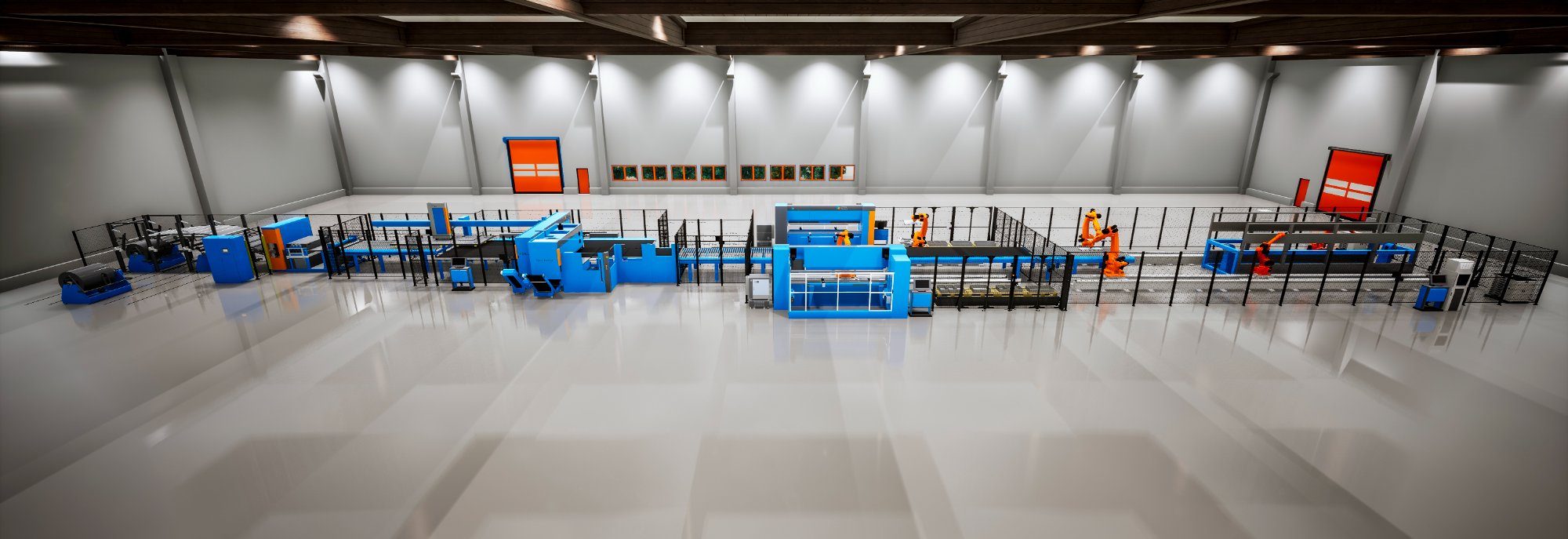
A fully robotised Prima Power line: coil, punch and shear, robotic bending, assembly and laser welding. Every station takes its parameters from USBSos — no paper work orders.

Rendered USBS factory: the full production line from coil handling to robotic welding cells in one hallUSBS factory · production line
Coil line → punch + shear
Robotic assembly + laser weld
18 starget takt per profile
3.1 hof line time per Vera Rubin Compute Cell (172.6 m² of cassette)
8 %of a year’s element output builds one complete reference facility — Shell and all 30 cells

What a whole facility costs the line. One reference facility is a 6 000 m² Shell — 6 000 m² of AP200 floor, 6 150 m² of YP200 roof and 2 560 m² of US100 envelope — plus 30 Vera Rubin Compute Cells at 172.6 m² of cassette each. That is about 19 900 m² of steel cassette, roughly 465 t of steel. Against a line output of 250 000 m² of cassette a year it is about 8 % — one line builds roughly twelve complete AI factories a year, and capacity for the cells themselves is set by fit-out bays, not by the line.

E Embodied carbon

The lowest-GWP AI factory frame.

Compute Shell and Cell are welded from SSAB Zero™ — steel made from recycled scrap with fossil-free electricity, carrying a verified EPD. The frame clears the carbon line on its own: no offsets, no certificates bought after the fact. The cooling adds no water use: dry coolers reject the heat without evaporation.

From 2029, embodied carbon enters EU data-center reporting. A frame that is light, bolted and relocatable is also the frame that scores.

0.83kg CO₂e/kgSSAB Zero™, verified EPD
−27%less steel per MW than a conventional hall
≈9.5t CO₂e/MWstructural frame of a cell-based facility calc
<2%site waste when the building is made in a factory

Frame embodied carbon, A1–A3, indexed to a concrete frame = 100. Frame only; MEP and payload excluded. EPD

50-YEAR FRAME · 4-YEAR PAYLOAD Steel frame — design for disassembly GPU generations → lift out, re-fit at the factory, lift back in year 02550

F Ecosystem

Who brings what. One owner of the whole.

SSABFossil-free steel, SSAB Zero™
Prima PowerThe coil-to-cassette robot line
NVIDIADSX Reference Design, OpenUSD, SimReady and Run:ai: the platform we build to
LineraMEP and BoS design
VexveValves and control for liquid cooling and heat recovery
CactosBattery storage and grid flexibility
Business FinlandR&D programme
UnitsolverPatented USBS frame, engines, factory, the whole facility

Build at the speed of your GPUs.

Tell us your site, your power and your first megawatt. We come back with a Shell, a cell count, a schedule, a carbon figure and a price for the whole facility: generated from your site, not estimated.